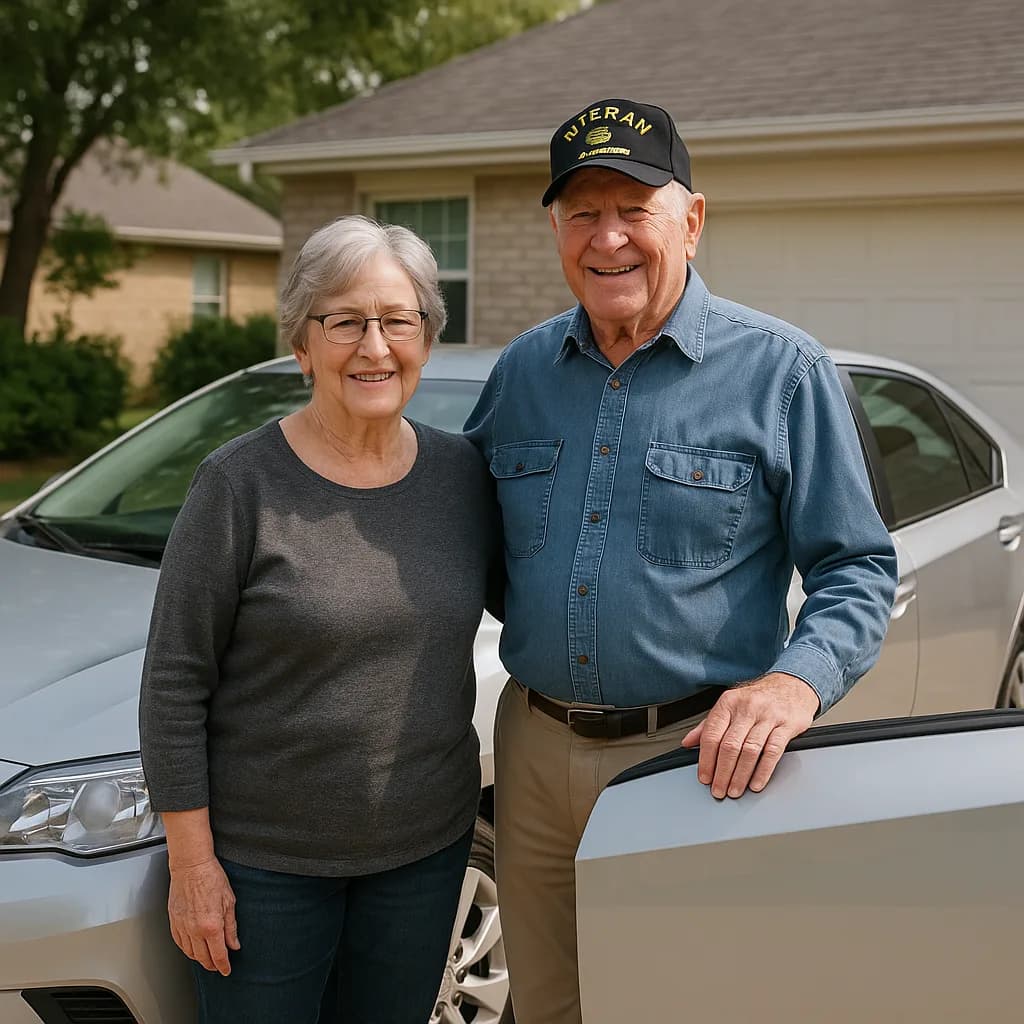
Why Your Premium Rose Despite a Clean Record
Your renewal notice arrived with a rate increase. Your driving record is clean, you've had no claims, and you drive fewer miles than you did during your working years. The carrier explanation lists only 'rate adjustment' or 'actuarial update.' What it does not say: Florida insurers adjust rates by age bracket, and crossing 65, 70, or 75 triggers a new tier regardless of your individual history.
You served, you've maintained a spotless record, and you assumed your veteran status and clean history would insulate you from increases. They do not. Florida law requires carriers to offer mature-driver discounts to drivers 55 and older, but it sets no statutory percentage—each insurer files its own amount. Most also offer veteran discounts as separate programs. The problem: both require you to ask and submit documentation. Your carrier will not automatically apply either at renewal, so qualifying veterans who never request both keep paying higher rates while neighbors with identical profiles save.
Compare rates from carriers that specialize in senior drivers
Mature driver discounts, low-mileage rates, and coverage reviews — see what you're actually eligible for.
Get Your Free QuoteFlorida Discount Age Floor
55+
Fla. Stat. §627.0652 requires insurers to offer mature-driver discounts to operators 55 and older, but the statute does not fix a percentage—the insurer sets the 'appropriate' amount. You must ask what yours is.
Fla. Stat. §627.0652
Two Discount Systems That Do Not Talk to Each Other
Florida's mature-driver discount is a state-mandated program tied to age. Veteran discounts are voluntary carrier programs tied to service status. They live in separate underwriting systems. Requesting one does not trigger the other. Your agent may apply the veteran discount when you first bind coverage and never mention the mature-driver option because you were under 55 at the time. Five years later, you cross the age threshold and the mature-driver discount becomes available—but no one tells you.
The reverse happens just as often: you enrolled at 60, the carrier applied the age-based discount, and your DD-214 sat in a file drawer because no one asked about service. Both discounts can apply simultaneously on most policies. State Farm, GEICO, Progressive, and USAA all allow stacking when eligibility is documented. But stacking requires two separate requests and two separate documentation submissions.
Most senior veterans discover this structure only after a neighbor mentions their rate or an adult child reviews the policy and asks why the declarations page shows only one discount line. By that point, you have paid full rates for years on a discount you qualified for the entire time.
The carrier will not cross-check your age against your service record and apply both discounts automatically. You must request each one separately and submit proof for both.
What Documentation Each System Requires

For the mature-driver discount: Florida statute requires completion of an approved defensive driving or mature-driver course. The course must appear on the state's approved-provider list, maintained by the Department of Highway Safety and Motor Vehicles. Online courses from AARP, AAA, and the National Safety Council qualify. Completion generates a certificate with a course completion number and expiration date. You submit the certificate to your carrier, and the discount applies at the next renewal. The certificate typically expires after three years, and you must re-enroll and resubmit to maintain the discount.
For the veteran discount: you submit a copy of your DD-214 showing honorable discharge or other qualifying separation status. Some carriers accept a veteran ID card or a letter from the VA. USAA requires proof of eligibility at enrollment but applies the discount automatically once verified. Other carriers require you to request the discount explicitly even after the DD-214 is on file. The veteran discount does not expire, but if you switch carriers, you must resubmit documentation—the new insurer does not inherit it from your prior policy.
Related Articles





How Renewal Timing and Certificate Expiration Interact
The mature-driver certificate expires three years from the course completion date, not from the date you submitted it or the date your policy renewed. If you completed the course in March 2022 and your policy renews in October, the certificate expires in March 2025. Your October 2024 renewal will carry the discount. Your October 2025 renewal will not, because the certificate expired five months earlier. The carrier will not notify you that the discount is about to lapse. It disappears at renewal, and your premium increases.
Most senior veterans discover the lapse only when they compare the current renewal notice against last year's and see the discount line missing. By that point, the premium has already adjusted. Re-enrolling in the course and submitting a new certificate restores the discount, but only at the following renewal—you cannot apply it mid-term. The gap costs you six months to a full year of higher premiums.
Veteran discounts do not expire, but they can disappear if your carrier re-underwrites your policy after a claim, a coverage change, or a household driver addition. The system treats the re-underwriting event as a new policy, and unless you re-request the veteran discount and resubmit the DD-214, it does not carry forward. This happens most often when you add a grandchild to the policy or when you file a comprehensive claim and the carrier moves you to a different rate class.
Carriers Writing Florida
25
At least 25 carriers write auto policies in Florida and file mature-driver discount programs. GEICO, Progressive, State Farm, USAA, Nationwide, and Allstate all allow veteran and mature-driver discounts to stack when documented separately.
Florida carrier filings
Which Carriers Handle Senior Veteran Profiles Well
USAA writes only military-affiliated households and applies both discounts without requiring separate requests once eligibility is verified. If you qualify for USAA membership, it is the cleanest path. State Farm and GEICO both allow stacking and process mature-driver certificates quickly, but you must request each discount separately. Progressive's Snapshot telematics program can deliver additional savings for low-mileage senior drivers, but the mature-driver and veteran discounts require separate enrollment.
Carriers in Florida's non-standard tier—Acceptance, Dairyland, Bristol West—write high-risk and post-violation profiles and offer veteran discounts, but their mature-driver programs vary. Some require phone enrollment rather than online submission. If your profile includes a recent lapse, a suspended license reinstatement, or an FR-44 filing, these carriers may be your only options, and the discount structure becomes secondary to coverage availability.
Compare Carriers With Both Discounts Applied
When you request quotes, tell every carrier you are a veteran aged 55 or older and ask what both discounts are before they generate the premium. Do not accept a quote that applies only one. If the agent says the system applied the veteran discount automatically, ask explicitly whether the mature-driver discount also appears on the quote. If it does not, ask what course completion would change the rate to. The difference is the value of enrolling.
Request quotes from at least three carriers that write your profile. GEICO, Progressive, and State Farm all quote online and allow you to enter both veteran status and course completion during the quoting process. USAA requires membership verification before quoting but applies both discounts at bind if you qualify. Compare the final premium with both discounts applied, not the base rate before discounts. The base rate is irrelevant—you will never pay it.
If your current carrier applied only one discount and you have been with them for years, request the second one before you shop. They may apply it retroactively to the current term or at the next renewal. If they do, compare that adjusted rate against new-carrier quotes. Loyalty does not guarantee the lowest rate, but switching costs time, and if your current carrier's adjusted rate is competitive, staying avoids the re-enrollment friction.
Request Both Discounts From Your Current Carrier Now
Call your carrier or log into your account portal. Ask whether your policy currently reflects both a veteran discount and a mature-driver discount. If only one appears, ask what documentation you need to add the other. If neither appears, ask what both require and request the forms. Submit your DD-214 and your mature-driver course certificate in the same interaction. Confirm that both discounts will apply at your next renewal and ask for a revised premium estimate in writing. If the carrier cannot apply both, that is your signal to compare quotes elsewhere.