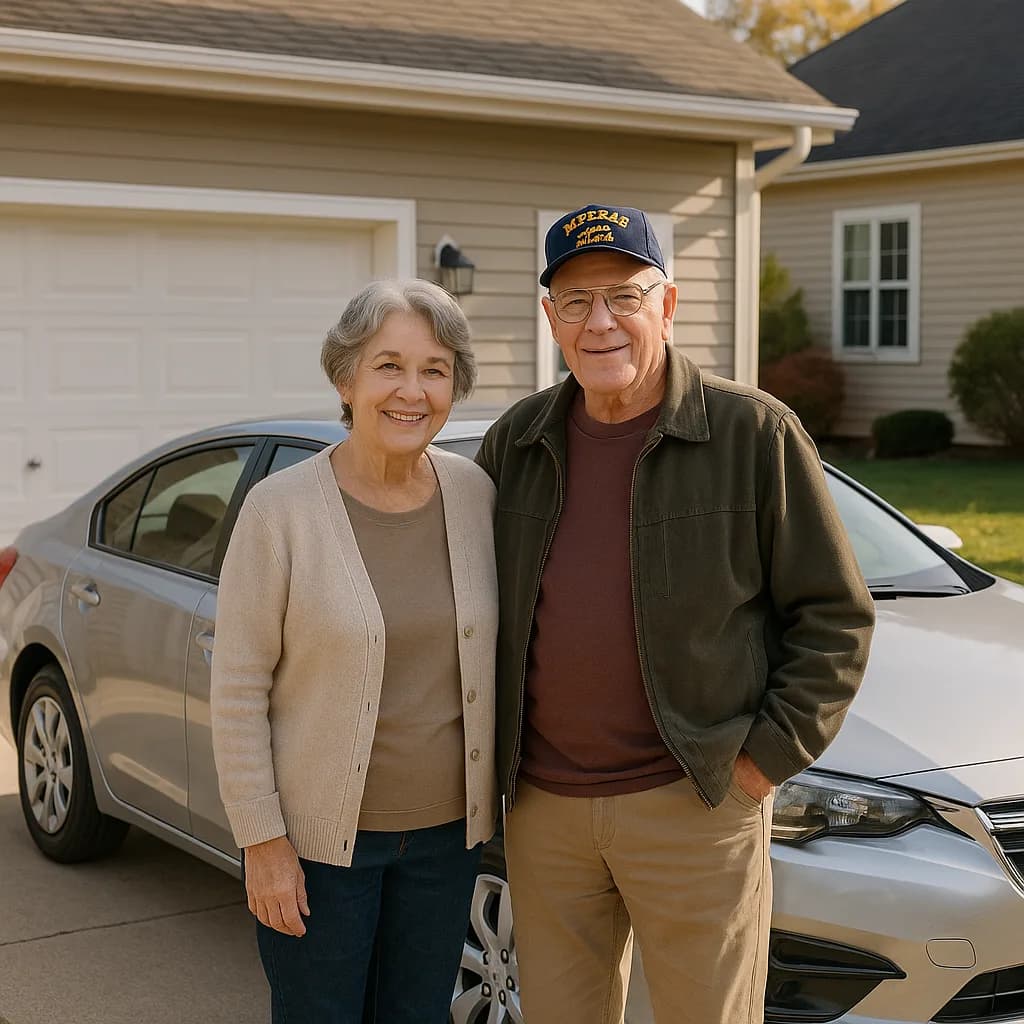
Why Your Premium Increased Despite Your Record
You opened your renewal notice and saw a rate increase you didn't expect. Your driving record is clean, your vehicle is the same, and nothing about your household changed. The increase came anyway, triggered by age-band actuarial adjustments most carriers apply at 65, 70, or 75. Colorado law does not prohibit age-based rating, so carriers price the statistical risk profile of your age bracket regardless of your individual history.
Veterans face the same age-factor pricing as civilian drivers, but two pathways can reduce what you pay: the state-mandated mature-driver discount and military-affiliation programs some carriers offer. Both require you to ask. Neither applies automatically at renewal, and most qualifying veterans never submit the documentation that triggers them.
Compare rates from carriers that specialize in senior drivers
Mature driver discounts, low-mileage rates, and coverage reviews — see what you're actually eligible for.
Get Your Free QuoteColorado Discount Age Floor
55+
Colo. Rev. Stat. §10-4-632 requires insurers to offer mature-driver discounts to operators aged 55 and older, but the statute sets no percentage—each carrier files its own amount. You must request the discount and submit course completion proof.
Colo. Rev. Stat. §10-4-632
What Colorado Law Actually Requires
Colorado statute mandates that every insurer writing auto policies in the state must offer a mature-driver discount to operators 55 and older. The law uses the phrase 'appropriate reduction' but does not fix a percentage. Each carrier sets its own discount amount through rate filings with the Colorado Division of Insurance, so the reduction varies by company.
The discount is not age-based alone. Most carriers require completion of a state-approved defensive driving or mature-driver course and submission of the certificate. The course must appear on Colorado's approved-provider list; courses from out-of-state providers or online platforms not on the list will be rejected at renewal, and the discount won't apply.
Veterans often assume military driving experience or safety training satisfies the requirement. It does not. The statute ties the discount to civilian defensive driving course completion, not military service. Your DD-214 and clean record support your application, but the certificate is what the carrier requires to apply the discount.
The blocker: you don't know which carriers offer the largest mature-driver discount percentage, and the law doesn't require them to publish it before you request a quote.
How to Request the Discount from Each Carrier

First, enroll in a state-approved defensive driving or mature-driver course. Colorado's Division of Motor Vehicles maintains the approved-provider list; verify your course provider is on it before you pay. Most approved courses are offered in-person through AARP, AAA, and local senior centers, and some are available online. Course length is typically four to eight hours, and you receive a certificate upon completion. The certificate is valid for a set period—usually three years—but some carriers require re-enrollment at each renewal cycle.
Second, contact your current carrier and ask what mature-driver discount percentage they apply and whether they require course completion or age alone. If they require the course, ask whether they accept the certificate you earned and whether the discount renews automatically or requires resubmission. Then request quotes from at least three other carriers writing in Colorado and ask the same questions. USAA, GEICO, State Farm, Progressive, and Nationwide all write standard and preferred policies in Colorado and offer mature-driver discounts, but the percentage varies. USAA restricts eligibility to military members, veterans, and their families, and often offers the most competitive rates for veterans with clean records.
Related Articles





Military-Affiliation Programs and How They Stack
Some carriers offer military-affiliation discounts separate from the mature-driver discount, and the two can stack. USAA underwrites exclusively for the military community and structures its rates with veteran profiles in mind from the start. GEICO, Armed Forces Insurance, and Navy Federal also offer military discounts, though eligibility rules and discount amounts vary by carrier and are not published in rate filings.
The military discount typically applies to the base premium before the mature-driver discount is calculated, so both reductions compound. Ask each carrier whether their military discount and mature-driver discount stack, and request a quote breakdown showing both line items. If the carrier cannot show you the breakdown, request it in writing or move to a carrier that will.
Veterans with VA disability ratings may qualify for additional state or carrier-specific benefits. Colorado offers property tax exemptions for disabled veterans, but these do not extend to auto insurance premiums. Some carriers offer separate disability-related discounts; ask whether your VA rating qualifies and what documentation they require.
Colorado Bodily Injury Minimum Per Person
$25,000
Colorado requires $25,000 per person, $50,000 per accident bodily injury, and $15,000 property damage. Veterans with retirement assets or home equity should carry higher liability limits—your assets are exposed in an at-fault accident, and the state minimum won't cover a serious claim.
Colorado Division of Insurance
Coverage Fit for Veterans on Fixed Income
Many veterans retire with paid-off vehicles and wonder whether full coverage still makes sense. The decision turns on vehicle value and replacement cost. If your vehicle is worth less than ten times your annual comprehensive and collision premium combined, dropping those coverages and keeping liability, uninsured motorist, and medical payments is often the better financial choice.
Medical payments coverage and personal injury protection overlap with Medicare and TRICARE, but they pay first in an accident and reduce out-of-pocket costs before your health coverage applies. Colorado does not require PIP, but medical payments coverage is inexpensive and closes the gap between accident and Medicare processing. Veterans with TRICARE should confirm whether their plan coordinates with auto medical payments or whether it subrogate claims.
Uninsured motorist coverage is not required in Colorado, but it protects you when an at-fault driver has no insurance or insufficient limits. Colorado's uninsured motorist rate is moderate compared to neighboring states, but the coverage is inexpensive and worth carrying at limits matching your liability coverage.
Low-Mileage and Telematics Programs
Veterans who no longer commute often qualify for low-mileage discounts. Most carriers offer reduced rates for drivers logging fewer than 7,500 or 10,000 miles per year, but you must request the mileage tier change—it does not apply automatically when you retire. Some carriers verify mileage annually through odometer photos; others rely on self-reporting at renewal.
Telematics programs track driving behavior through a smartphone app or plug-in device and adjust your premium based on braking, acceleration, speed, and time of day. Progressive's Snapshot, State Farm's Drive Safe & Save, GEICO's DriveEasy, and Nationwide's SmartRide all operate in Colorado. Veterans with smooth driving habits and predictable schedules often see meaningful reductions, but the programs require you to opt in and share driving data. If you drive primarily during daylight hours and avoid hard braking, telematics is worth evaluating.
What to Do Right Now
Start by calling your current carrier and asking what mature-driver discount percentage they apply, whether it requires course completion, and whether it stacks with any military discount they offer. If they cannot answer or will not provide a quote breakdown, request quotes from USAA, GEICO, State Farm, and Progressive. Verify that the course provider you are considering appears on Colorado's approved list before you enroll. Submit your certificate to each carrier you quote with and ask them to confirm in writing that the discount has been applied. Compare the final premium, not the discount percentage alone—a smaller discount on a lower base rate often costs less than a larger discount on a higher one.